
Our guides are based on research and published information. Current shopping links are ordinary brand links; we do not earn commissions from them. Read our disclosure.
Plan by nights away, not by the size of the pouch
A three-night trip rarely calls for a miniature copy of your entire bathroom. Begin with the products you reliably use and the activities on your itinerary. A city break with dinner reservations creates a different makeup-removal task from a quiet visit to family. Write the routine for one normal morning and one normal evening, then remove optional steps you do not expect to use. This simple exercise keeps an attractive travel organizer from setting the size of your shopping list. A pouch is there to hold your essentials, not to create a reason to buy more.
Check the rules for the actual route
For U.S. security screening, TSA describes the familiar limit of containers holding 3.4 ounces or less for liquids, gels, aerosols, creams, and pastes, arranged in the permitted quart-size bag. Review current official guidance for your departure and connecting airports before packing, because this article cannot substitute for your route's requirements. Think about the container capacity, not merely how little remains inside a large bottle. Leave time to check any product you are uncertain about. Finding that a favorite oversized jar is unsuitable at the checkpoint is an avoidable and expensive way to edit your routine.
Choose familiar minis before a discovery set
Travel can already change your schedule, water access, and available counter space. A bundle of unfamiliar miniatures adds several purchase decisions just when you want fewer. If your regular product comes in an appropriate travel size, compare that with the cost and practicality of bringing an allowed original container. A discovery set can make sense when you independently wanted those products, but it is not automatically the economical choice. Count how many items you will genuinely use during the trip. One useful mini and four unwanted extras still make a poor travel purchase.
Treat decanting as a product-specific decision
Do not assume every formula should be transferred into a generic travel pot. Follow the manufacturer's packaging and storage guidance, and preserve essential directions and identifying information. Where transfer is appropriate, choose a container compatible with the product and label it clearly. Avoid mystery jars that leave you guessing in a hotel bathroom. Keep sunscreen in its original packaging so its directions and expiration information remain accessible. A matching set of little bottles can look tidy, but convenience should not come at the expense of knowing exactly what you packed and how to use it.
Pack for a small unfamiliar bathroom
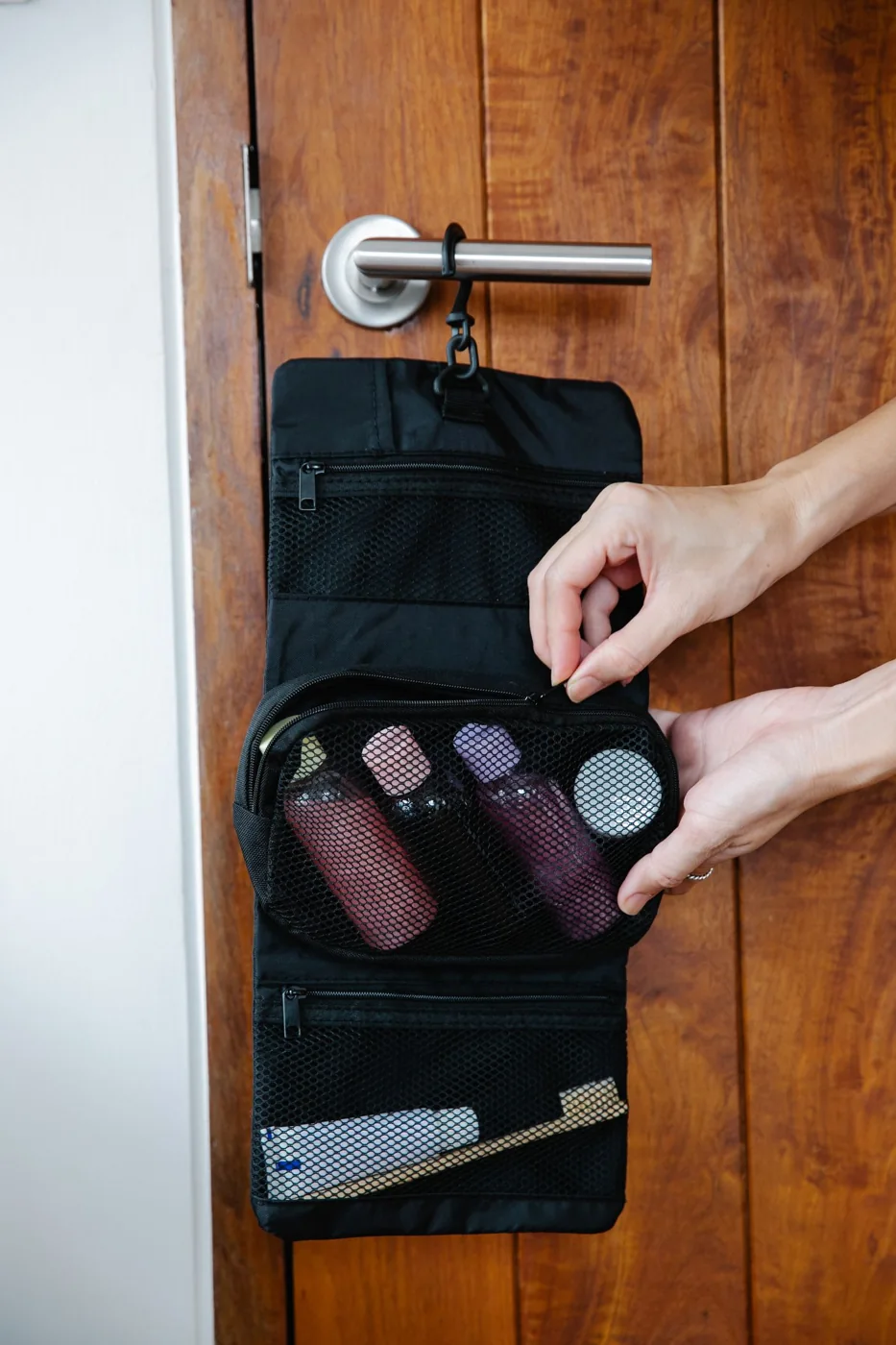
Imagine having one narrow ledge beside the hotel sink and nowhere convenient to place a sprawling bag. Upright tubes or a compact pouch that opens clearly may be more practical than a large foldout organizer. A hanging design is useful only when there is somewhere appropriate to hang it. Keep lids secure and place items in a way that contains potential leaks. Leave damp accessories out to dry as appropriate before repacking. A toiletry bag with an easily cleaned lining can be worth more to a frequent traveler than a complicated arrangement of tiny pockets.
Set a replacement budget before departure
Travel sizes often cost more per ounce, but a small purchase can still be sensible if it reduces waste and solves a real packing constraint. Compare the total you will spend rather than treating unit price as the only measure. Avoid buying a luxurious travel version of every product simply because the containers match. Spend first on the items you need to use correctly and consistently. If you can buy a routine replacement at your destination, consider whether that option is genuinely convenient rather than assuming you will have time to hunt for a shop after arrival.
Who should skip the elaborate travel organizer
Skip a large organizer if your kit consists of only a few compact essentials, and skip hard-sided containers that consume space without protecting anything important. Travelers moving between several locations may value easy access more than display-style organization. Before leaving, close the packed pouch and place it where it will actually ride in your luggage. Check that it fits without crushing caps or forcing a zipper. Keep your routine recognizable, your product information available, and your purchases limited to the constraints of the journey. That approach makes unpacking at home simpler as well.
Pack a small, familiar routine and check the official security rules for your route before purchasing travel containers.
A few more things to know
Does a half-empty large bottle count as a small container?
For the TSA liquids rule, check the stated container-size limit rather than relying on the amount remaining in a larger bottle.
Is a complete miniature routine worth buying?
Only when you want and will use the included products. Separate minis can be a better fit for a short trip.
Sources & further reading
Sources consulted September 30, 2026. Product details can change.